 Pin It
 I'll never forget the year my grandmother handed me her worn recipe box and said, 'This year, you're making the Thanksgiving centerpiece.' That's when I discovered 'Chains of the Mayflower'—a dish she'd created decades ago as a tribute to the journey, the hardship, and ultimately, the gratitude that defined that first harvest. The moment I arranged those golden root vegetables and turkey slices in overlapping chains across the platter, I understood. It wasn't just food; it was a edible family tree, a visual reminder that we're all connected through time, tradition, and shared meals.
I remember the first time I made this for my own table, my five-year-old asked why the vegetables were arranged like a chain. When I explained the story of the Mayflower and how people came from across the ocean seeking a new home, she connected each link with her finger and said, 'Like our family is connected too.' That's when I knew this recipe would become our family tradition, the one dish that tastes like love and history on the same plate.
Ingredients
- Boneless turkey breast, skin on (1.5 kg/3.3 lbs): The skin is your secret to juicy meat and gorgeous golden color. I learned years ago that keeping the skin on makes all the difference between dry turkey and something that stays tender and flavorful through resting.
- Olive oil (4 tbsp total): This is your base for flavor and the vehicle that carries those herbs into every fiber of the meat. Use a good quality oil you'd actually taste on its own.
- Dried thyme and sage (1 tsp each): These herbs are the voice of autumn in this dish. Together they create that warm, harvest kitchen smell that announces dinner before anyone sits down.
- Salt and black pepper: Don't skip seasoning the turkey directly. It's not just about taste; it's about building layers of flavor that make people ask for your recipe.
- Large carrots, parsnips, sweet potatoes, and celery root: The root vegetable combination is what makes this special. Each brings something different—carrots bring sweetness, parsnips add earthiness, sweet potatoes deepen the color and flavor, and celery root brings subtle sophistication. Don't substitute them with just potatoes; the variety is the whole point.
- Smoked paprika and ground cumin (1 tsp and ½ tsp): These spices add warmth and a subtle smokiness that ties the dish together. The paprika gives that beautiful color, while cumin adds a quiet complexity.
- Unsalted butter and cornstarch for gravy: Butter makes everything better, and cornstarch is your friend for a silky, lump-free gravy that coats the back of a spoon without flour.
- Chicken or turkey stock (500 ml/2 cups): Quality stock is non-negotiable. It's the difference between good gravy and forgettable gravy. If you have homemade, use it.
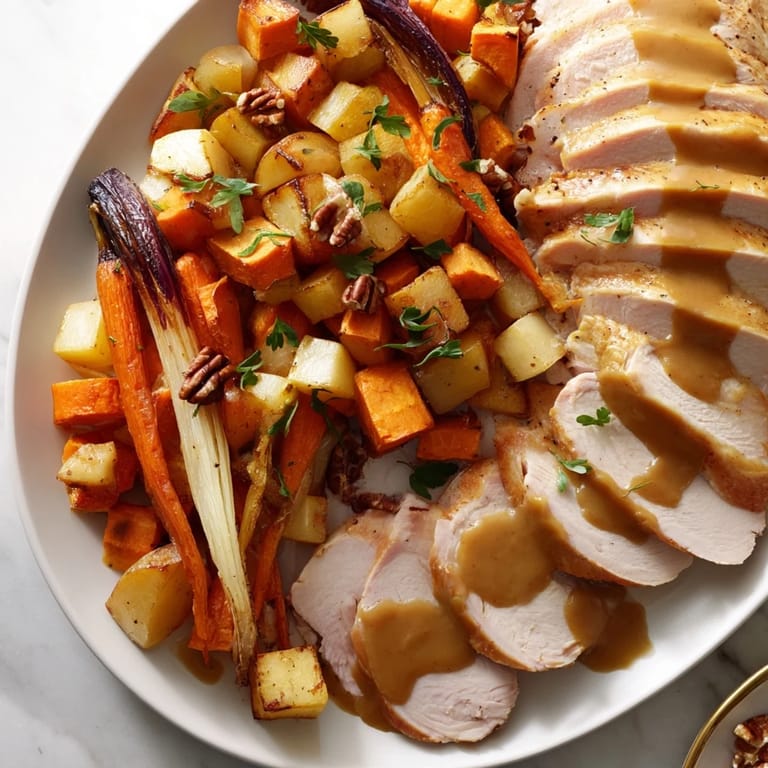
- Fresh parsley and toasted pecans for garnish: These aren't afterthoughts. The bright green parsley against the golden vegetables brings the whole dish alive, and toasted pecans add a nutty crunch that echoes the season.
Tired of Takeout? 🥡
Get 10 meals you can make faster than delivery arrives. Seriously.
One email. No spam. Unsubscribe anytime.
Instructions
- Prepare your oven and season the turkey:
- Start by preheating your oven to 200°C (400°F). While it's warming, pat your turkey breast dry with paper towels—this helps the skin get crispy. In a small bowl, mix together your olive oil, thyme, sage, salt, and pepper. This fragrant paste is going to coat every inch of the turkey. Massage it in gently, making sure to get some under the skin if you can. You'll know you're doing it right when your kitchen starts smelling like a cozy autumn evening.
- Roast the turkey to golden perfection:
- Place your seasoned turkey skin-side up in a roasting pan. Let it go into that hot oven for about 1 hour and 15 minutes. You're looking for the internal temperature to reach 74°C (165°F) measured at the thickest part. The skin should be deep golden brown and crispy. Every 30 minutes, give the pan a little rotation if you notice one side browning faster than the other. When it's done, pull it out and cover it loosely with foil, then let it rest for 15 minutes. This resting time is sacred—it lets the juices redistribute, keeping every slice tender and juicy.
- Prepare and roast the root vegetables:
- While the turkey is roasting, prep your vegetables. Cut everything into roughly 1-inch pieces so they cook evenly. Toss them in a bowl with olive oil, smoked paprika, cumin, salt, and pepper until every piece is coated. Spread them out on a baking sheet in a single layer—don't crowd them, or they'll steam instead of roast. Put them in the oven for 40 to 45 minutes, stirring them halfway through. You'll know they're ready when the edges are caramelized and golden, and a fork slides through easily. The kitchen will smell absolutely incredible.
- Make the silky gravy:
- About 10 minutes before everything comes out of the oven, start your gravy. Melt butter in a small saucepan over medium heat. Once it's foaming and fragrant, whisk in the cornstarch until it's completely smooth with no lumps. This is the base that'll keep your gravy from being grainy. Slowly pour in your stock while whisking constantly. Keep whisking—this is where patience pays off. Once it's smooth and starting to thicken, add the soy sauce for depth. Let it simmer for another 5 to 7 minutes, stirring occasionally, until it coats the back of a spoon. Taste it and add salt and pepper as needed. It should be rich, glossy, and taste like the best part of Thanksgiving.
- Create the symbolic chain arrangement:
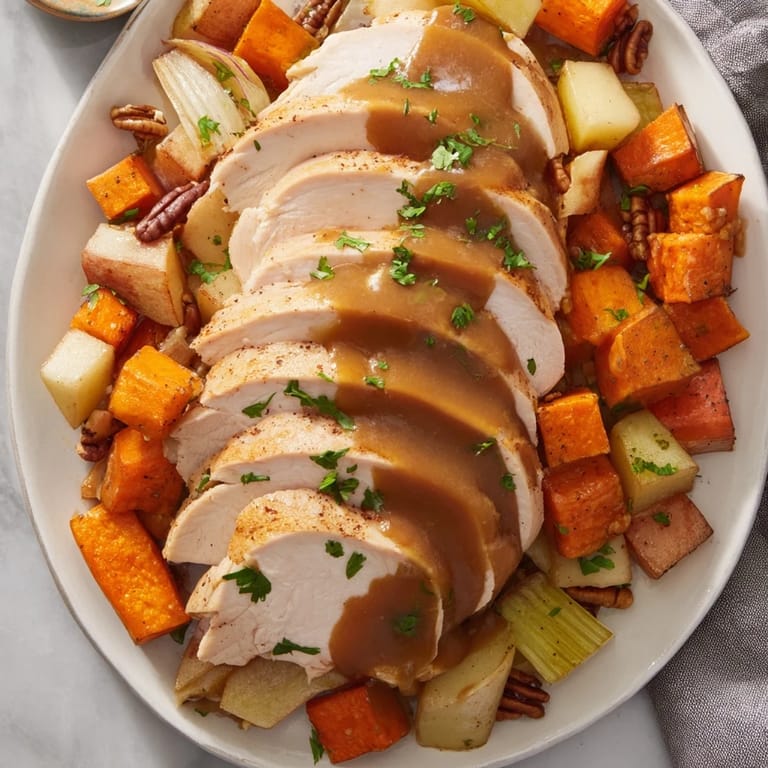
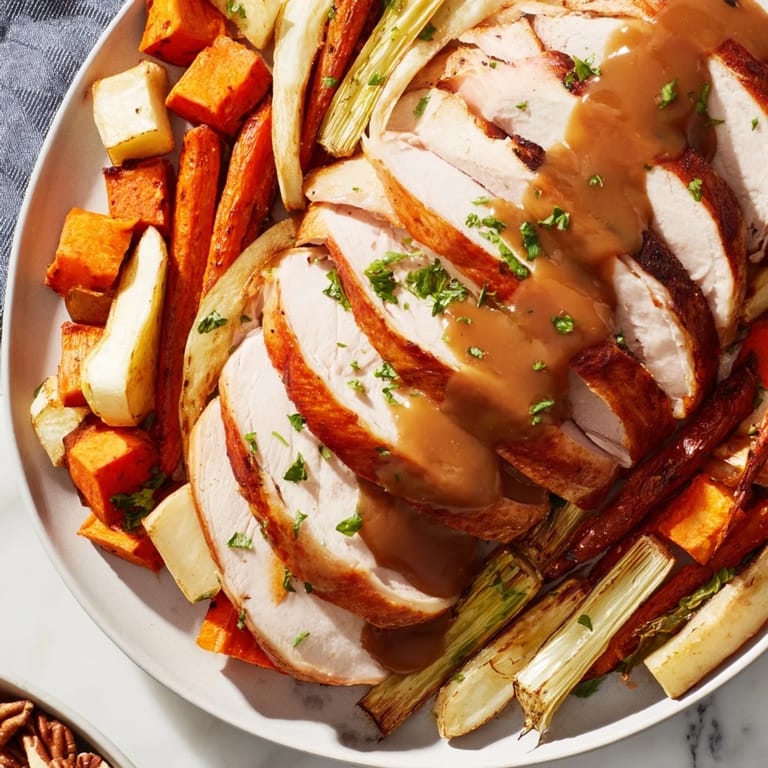
- Now comes the part that makes this dish truly special. Slice your rested turkey into ½-inch thick pieces. On a large platter, arrange your roasted vegetables and turkey slices in overlapping rows, creating a chain-like pattern that echoes links connected to one another. You can arrange them in concentric circles, or in a winding pattern—whatever speaks to you and the story you want to tell. The arrangement itself becomes the conversation starter. Drizzle your beautiful gravy over everything, letting it pool slightly in the gaps. Finish with a generous scatter of fresh chopped parsley and toasted pecans if you're using them. Step back and look at what you've created—it's not just food, it's a story on a plate.
 Pin It
 There's a moment, right before everyone sits down, when the platter is complete and the gravy is perfect and the steam is rising up from all those roasted vegetables, that I stop and just look at it. That's when I think about my grandmother, and all the hands that have prepared food for all the people they loved. That's what this dish is really about—the chain of people, stretching back through time, all gathered around tables, all fed by someone who cares.
The Story Behind the Chains
When my grandmother created this recipe, she was thinking about symbolism. Each link in the chain represents a person, a family, a story. The Mayflower didn't arrive empty—it carried dreams and hopes and people willing to start over. Over centuries, those chains of connection have grown stronger. Every time you arrange this dish on a platter, you're recreating that journey and celebrating the bonds that tie us to each other. It's why the arrangement matters as much as the taste. When guests see it, they understand immediately that they're part of something bigger than just a meal.
Making It Your Own
The beauty of this recipe is that it's a framework for your own creativity and traditions. My cousin makes it with roasted Brussels sprouts added in for extra earthiness and color. My friend's family uses it as their vegetarian centerpiece by replacing the turkey with thick slices of roasted portobello mushrooms that have been marinated in the same herbs and oil. The gravy becomes vegetable-forward, rich and deep. Some years, I've added roasted beets to bring a jewel-toned richness to the platter. The core of the recipe—the technique, the symbolism, the love—stays the same. Only the details shift to match your table and your traditions.
Serving and Storing Your Masterpiece
This dish is best served fresh and warm, when the turkey is still tender and the vegetables still have that slight firmness that means they were perfectly roasted. Serve it family-style, letting people serve themselves from the platter so they can appreciate the arrangement. A small bowl of extra gravy on the side means everyone gets as much richness as they want. If you have leftovers—though with a dish this beautiful, that's not always the case—they keep beautifully in the refrigerator for up to three days, covered. Reheat gently in a warm oven until everything is heated through. Cold leftovers make an extraordinary sandwich the next day, especially with a smear of cranberry sauce on toasted bread.
- Cranberry sauce adds a bright, tart contrast that cuts through the richness beautifully
- A crisp salad with a sharp vinaigrette on the side balances the roasted warmth perfectly
- Serve this with good bread to soak up every drop of that golden gravy
 Pin It
 This dish reminds us that the best meals are the ones that taste like history and love on the same plate. Every time you make it, you're continuing a tradition, adding your own chapter to a story that stretches back through the generations.
Recipe FAQs
- → How can I ensure the turkey stays moist while roasting?
Rub the turkey breast with oil and herbs before roasting, and rest it covered with foil after cooking to retain juices.
- → What root vegetables work best for roasting in this dish?
Carrots, parsnips, sweet potatoes, and celery root offer a balanced earthy sweetness and texture when roasted together.
- → How is the gravy thickened and flavored?
The gravy is thickened with cornstarch and enhanced with butter, chicken or turkey stock, and a touch of soy sauce for depth.
- → Can this dish be adapted for vegetarians?
Yes, replace turkey with roasted portobello mushrooms and use vegetable stock to keep flavors rich and satisfying.
- → What garnishes complement this dish?
Fresh chopped parsley and toasted pecans add brightness and a crunchy contrast to the warm roasted flavors.